3/4 Collectivism: Putting the Group First
Japan’s collectivist culture places a high value on group harmony (wa), shared responsibility, and loyalty. In this framework, individual actions are seen as reflections of the entire group—whether it’s a family, company, or society.
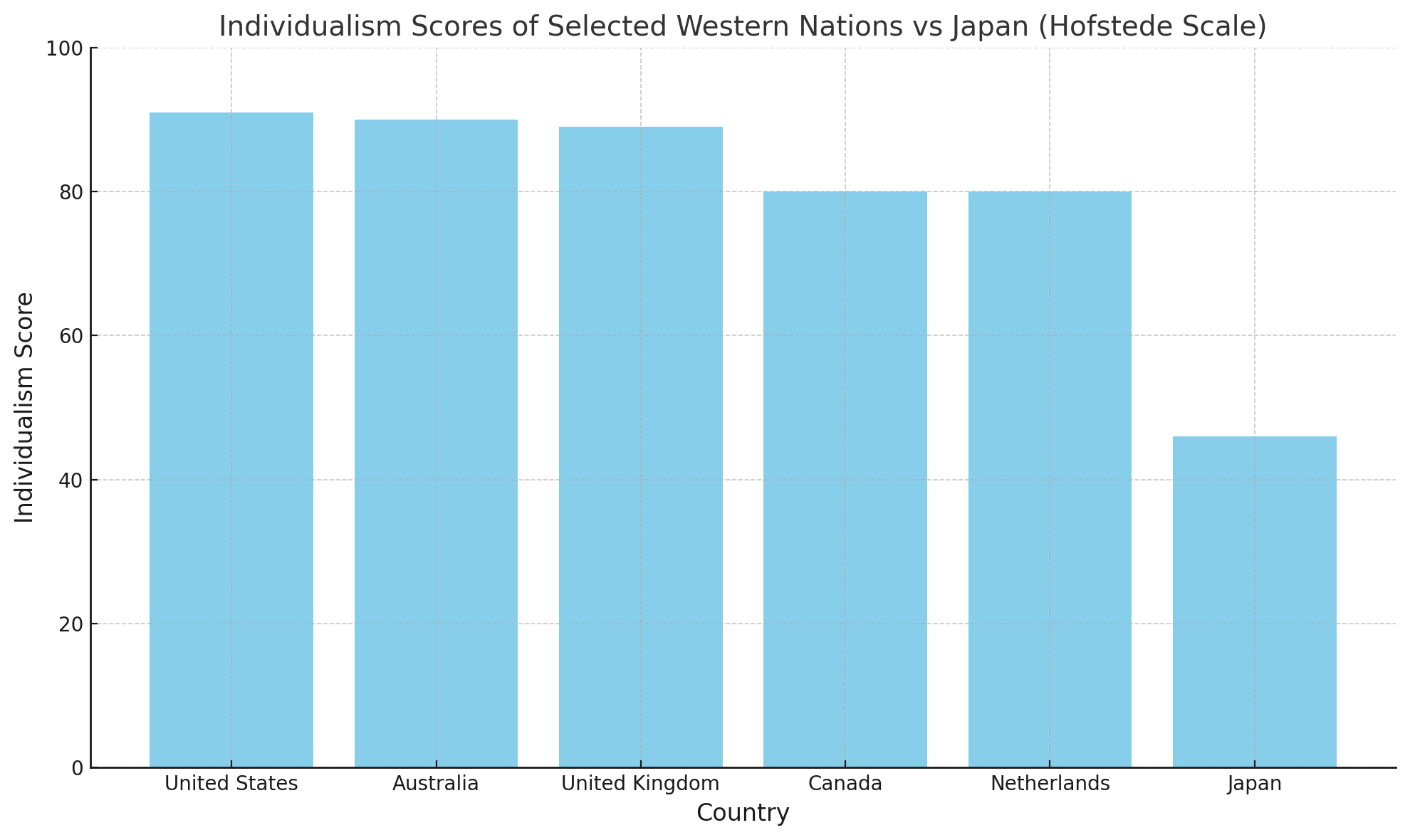
Sociologist Geert Hofstede, as part of his Cultural Dimensions Theory, highlighted Japan’s high “collectivism score,” indicating a strong preference for group cohesion over individualism. Japanese society differs greatly from the indidualism displayed in many western countries, as shown in the chart below.
In collectivist societies, people see themselves as part of a larger group, so they focus on keeping harmony, sharing responsibility, and following social norms. Decisions are usually made with others in mind, often after checking with family, colleagues, or elders to make sure everyone is on the same page. People also defer to hierarchy, showing respect to authority figures and senior members to keep things stable. Emotions and behaviour are managed carefully to avoid causing disruption—humility and gratitude are encouraged, while pride or frustration are often toned down. Motivation comes from social approval and fulfilling obligations, with a strong emphasis on being a valuable part of the group.
So how does collectivism affect customer experience?
In customer service, collectivism fosters an environment where employees consistently strive for excellence, not for personal gain but to uphold their organisation’s reputation and ensure harmony. Along with the previously discussed phenomenon of uchi and soto, AND shame, this cultural mindset helps explain why Japanese customer service remains consistently outstanding across industries.
This combination of phenomena works in unison to create the unbeatable Japanese customer service that filters down from the most high-end boutiques to local convenience stores across Japan. But what can those of us non-Japanese take from this understanding and how can we apply it to a company and service to improve customer experience levels? Check out part 4 of this series, where I provide my take on how we can all take on the lessons of Japan’s customer service culture.